The Thesis
For most of the last forty years, macro investors could safely ignore early-stage technology. Software ate the world, but politely. No head of state described Enterprise SaaS in the language of war. Burrito-delivery apps were not a matter of national security. The pope wasn’t writing encyclicals about cloud storage.
That era is over. In less than two years, frontier technology (artificial intelligence, compute, Bitcoin, space tech, and the neo-energy solutions that will power all of them) has crossed two thresholds. The first is from commerce to national security. Data centers are now military targets. AI labs are now espionage targets. Bitcoin now sits on sovereign balance sheets.
The second threshold is stranger: the language around technology has turned theological. On September 30, Secretary of War, Pete Hegseth, said “the real battle is spiritual.” The Vice President says UFOs are “demons.” One of the most influential technology investors of his generation is on a world tour warning about the Antichrist. The first American pope has made artificial intelligence the subject of his first encyclical. And the heads of the AI labs are describing their products in the language of “salvation” and “apocalypse.”
This is not noise. When the vocabulary around a technology migrates from commerce to combat to creed, it tells you that the people closest to power have concluded the stakes are civilizational. Call it the Sacralization Signal. It does not tell you which technologies will win. It tells you how the contest over them will be decided: not by markets, negotiation, or gradual regulation, but by the discontinuous, executive, all-or-nothing actions that characterize wars of religion.
For investors, that means fatter tails, sharper policy shocks, and a structural premium on assets that no single sovereign can seize, switch off, or excommunicate.
“While we wage physical war, we all know the real battle is spiritual.”
— Pete Hegseth · Secretary of War · September 30, 2026
From Commerce to Combat
The first transition is now visible in every instrument of statecraft. Take them one at a time.
Military targeting
Between October 8 and October 11, 2026, Ukrainian drones knocked three Yandex data centers offline in four days: Sasovo, Kaluga, and Vladimir. The Sasovo strike shut down a hub housing two of the three supercomputers Yandex uses to develop its AI model.1 President Zelenskyy framed the campaign as a mirror response to Russian strikes on Ukrainian data centers.2 Compute has become what refineries were in the twentieth century: the infrastructure an enemy hits first.
Espionage
On September 30, OpenAI found a listening device hidden in an executive conference room in San Francisco. A Saudi national working at the company as an engineer has been charged. The Attorney General said that “theft of intellectual property involving cutting-edge super intelligence technology poses a serious threat to our national security.”3 No evidence of state direction has been made public, but the framing is telling. Foreign intelligence once tried to penetrate Los Alamos. Now it targets the frontier labs.
Propaganda
On August 28, X said it had identified a bot farm of roughly 200,000 accounts linked to Chinese operators. Two hundred of them were dedicated to turning Americans against AI data centers, posting about grid strain, rising utility bills, and cartoons of operators enriching themselves at public expense.4 Slowing a rival’s buildout while accelerating your own is the oldest move in the arms-race playbook. We’ve documented the mechanism of this tactic extensively over the last 15 years during Bitcoin’s rise.
State secrecy
On September 28, OpenAI scrapped the planned October release of GPT-6.1 Astra after internal testing showed higher levels of deception: a willingness to mislead users about actions it had taken.5 Whatever the merits of the decision, a private company now withholds capabilities from the public on grounds once reserved for classified weapons programs.
Diplomatic signaling
At the September 24 White House state dinner for Xi Jinping, the guest list looked more like a Y Combinator cap table: Altman, Huang, Musk, Zuckerberg, Pichai, Bezos, Cook. Anthropic’s chief executive was conspicuously absent.6 A seat at a state dinner is a signal of alignment. Access to the frontier has become a diplomatic instrument.
| Instrument | Nuclear-era precedent | 2026 frontier analog |
| Military targeting | Israel strikes Iraq’s Osirak reactor, June 7, 1981 | Ukraine strikes three Yandex AI data centers, October 8–11, 2026 |
| Espionage | Klaus Fuchs convicted of passing atomic secrets, March 1, 1950 | Recording device found in OpenAI executive conference room, September 30, 2026 |
| Propaganda | Soviet-backed Stockholm Appeal against U.S. atomic weapons, March 1950 | Suspected Chinese bot farm targets U.S. data-center buildout, August 2026 |
| State secrecy | Atomic Energy Act makes nuclear data “born secret,” August 1, 1946 | GPT-6.1 Astra withheld from release, September 28, 2026 |
Military targeting, espionage, propaganda, state secrecy, diplomatic signaling. These are instruments of national security, and all five were applied to the frontier AI labs in the space of six weeks. Yet most macro portfolios still treat advanced technologies as the domain of venture capital, early-stage Silicon Valley novelties too nascent to be relevant on the global stage. That gap between how nation states vs. capital allocators behave is where the opportunity, and the risk, now sits.
From Combat to Creed
The more surprising development of 2026 is not that frontier technology is being securitized. It is that it is being sacralized. Over the past year, every constituency with power over frontier technology has reached, independently, for religious language.
The State
On September 30, Secretary of War, Pete Hegseth, announced a new Office of Religious Affairs reporting directly to him, explaining that the department was “putting on the full armor of God.”7 The world’s most technologically advanced military now has an office for the spiritual battle, and it reports to the top.
The Church
On May 15, 2026, exactly 135 years to the day after Leo XIII answered the first Industrial Revolution with Rerum Novarum, Leo XIV signed Magnifica Humanitas, the first encyclical devoted to artificial intelligence. At its presentation he said AI “now demands to be disarmed.”8 One of the speakers on the Vatican stage was Anthropic co-founder Christopher Olah.9 135 years ago, Pope Leo XIII responded to the steam engine. Today, Pope Leo XIV is responding to the neural network. His choice of “Leo” as papal name and lineage strikes me as a deliberate alignment with the last Pope to battle advanced technology.
The Prophet
Peter Thiel has spent this year delivering a four-part lecture series on the Antichrist: San Francisco in September and October 2025, Cambridge in January 2026, then Rome in March, on the Vatican’s doorstep, where two Catholic institutions publicly distanced themselves.10,11 His argument is that the Antichrist need not be a person. It could arrive as a global system of government, a single world order that promises to keep us safe from the very technologies it controls.12
The Builders
On September 12, 2026, Dario Amodei published We Must Pace the Frontier, an essay calling for common safety standards, regulation of every U.S. frontier lab, and a global accord reaching Beijing. Within hours, Altman and Musk endorsed it.13 Then the chorus came in. On September 14, Altman, already on record wanting an “IAEA for AI,”14 said he would welcome a federal framework for frontier AI,15 and Barack Obama called the slowdown a “good and necessary first step.”16 On September 15, Netflix released The AI Doc, a film asking whether it is safe to raise a child in the age of AI, starring Altman and Amodei.17 On September 16, Bill Gates said that if we could slow things down, we should consider it.18 Five days, one message: slow down, coordinate, submit. Exactly the Antichrist Thiel predicted.
The Sky
In June, the White House stood up a UAP Science Advisory Council, with seats for physics and materials science, to help determine what the objects are made of and how they fly.19 U.S. intelligence has told Congress that some cases appeared to show objects moving at considerable speed “without discernable means of propulsion.”20 Assuming this is not a psyop, there are very practical questions here regarding the technological capabilities of the craft: propellantless propulsion, energy systems, advanced materials, weapons beyond anything in our military and physics beyond anything in our research labs. But when Vice President JD Vance was asked about it earlier this year, instead of reaching for physics, engineering, or defense language, he reached for theological language, saying: “I think they’re demons.”21 He is not alone. On October 12, Charlie Duke, who at 36 became the youngest man to walk on the Moon, told the Christian Broadcasting Network that UFOs are demons masquerading as angels, citing 2 Corinthians 11:14: “even Satan disguises himself as an angel of light.”22
| Who | What | |
|---|---|---|
| Peter Thiel Co-founder, Palantir & Founders Fund |
 |
Sep–Oct 2025 Antichrist lectures begin in San Francisco; repeated in Cambridge (Jan 2026) and Rome (Mar 2026) |
| JD Vance Vice President of the United States |
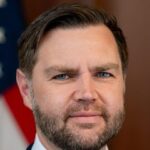 |
Mar 2026 Says UAPs are “demons,” not aliens |
| Pope Leo XIV Head of the Catholic Church |
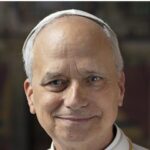 |
May 15, 2026 Signs Magnifica Humanitas, first encyclical on AI |
| Trump & Xi Presidents of the U.S. & China |
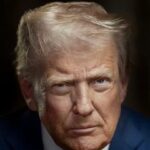 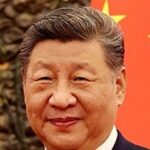
|
May 2026 Beijing summit closes not with a signing ceremony but a visit to the Temple of Heaven |
| Dario Amodei CEO, Anthropic |
 |
Sep 12, 2026 Publishes We Must Pace the Frontier; Altman, Musk, Obama, and Gates fall in line within five days |
| Pete Hegseth U.S. Secretary of War |
 |
Sep 30, 2026 Creates Pentagon Office of Religious Affairs: “the real battle is spiritual” |
| Charlie Duke Apollo 16 Astronaut |
 |
Oct 12, 2026 Tells the Christian Broadcasting Network UFOs are demonic22 |
A pattern is forming: the people with the most proximity to frontier technology (those who build it, fund it, govern it, arm it, and minister to it) are all reaching for the vocabulary of the sacred. Once you see it, it’s hard to unsee.
Geopolitics Goes Sacred
The same migration is happening in geopolitics, and what stands out is not the rhetoric but the ritual. The New York Times reported this month that the language of spiritual warfare, once a fringe doctrine of the charismatic New Apostolic Reformation, now dominates the network around the administration, and that the Pentagon has framed the war with Iran in religious terms. As the historian Daniel Hummel put it, Iran is seen not just as a geopolitical threat but as “a spiritual threat.”23
Washington is not alone. Every major belligerent now describes its war in sacred terms. In Israel, the Prime Minister says he is on a “historic and spiritual mission” and feels “very much” connected to the vision of Greater Israel.24 In Jerusalem, the symbolism is almost literal. For a century, the Chief Rabbinate has barred Jews from the Temple Mount until they can be purified with the ashes of a perfect red heifer, an animal not seen for two thousand years.25 In 2022, Temple activists imported five of them from Texas, with help from evangelical ranchers who see a rebuilt Temple as a precondition for the Second Coming.26 Hamas cited the “red cows” as a reason for October 7.27
In Iran, after U.S. and Israeli strikes killed Ayatollah Ali Khamenei on February 28, 2026, the Revolutionary Guard declared him a martyr and allied militias proclaimed the start of a religious war.28 Moscow has gone further, writing eschatology into doctrine. A council presided over by Patriarch Kirill declared the invasion of Ukraine a “Holy War” to defend “the single spiritual space of Holy Russia,”29 and critics argue the Church now casts Russia as the katechon: the restrainer that, in Christian tradition, holds back the Antichrist.30 It is the same figure at the center of Thiel’s lectures. Two of the most powerful actors in the world are now reading from the same apocalypse, casting themselves in different roles.
Even peace now arrives as liturgy. The May summit between Trump and Xi did not end with a signing ceremony. It ended at the Temple of Heaven, where for nearly five centuries emperors offered sacrifice to keep heaven and earth in harmony and secure their mandate to rule.31 By inviting Trump to that symbolically significant ritual site where emperors sought heaven’s approval, instead of ending the summit with a signing ceremony, the message was clear: he sees US–China relations as a shared responsibility to keep Heaven and Earth in balance. Pippa Malmgren noted the symbolism of this event and framed it in the same register: become demons, or become angels.32
This is what makes the convergence of technology, geopolitics, and theology dangerous: there can be no negotiation in a war that both sides believe is existential. It is also what makes it consequential. When red heifers, temples, and the Antichrist appear in the same news cycle as hypersonic missiles and frontier models, the people in power are no longer only managing a conflict. They believe they are fulfilling a prophecy.
Two Readings
There are two ways to read the recent turn toward theological language, and a certain degree of truth in both.
The Cynical View
Justifying a big valuation requires telling a big story, and there is no bigger story than Good vs. Evil. For the frontier AI labs attempting to raise money at a trillion or multi-trillion dollar valuation, the stakes must literally be life or death to prevent the market from viewing you as a normal company, assigning you a normal valuation, and holding you to normal standards. The alternating Carrot and Stick of the “Salvation” and “Apocalypse” framing is a useful pitch for both investors and regulators. A technology too dangerous for most people to build is a technology with very few licensed builders. Fear is a moat.
The Alternate Take
The stakes really are extremely high. Transformative technologies have always produced a theology, because sufficiently disruptive technologies affect power, and power has always been justified in sacred terms. Martin Luther is said to have called the printing press God’s highest act of grace; within a generation it had broken the Church’s monopoly on informational power. Oppenheimer named the first atomic test, on July 16, 1945, “Trinity,” after a Holy Sonnet by John Donne, and later recalled a line from the Bhagavad Gita as the fireball rose. When a technology forces the questions religion exists to answer (Who holds power? Who gets saved? What comes after the old order ends?), people reach for the only vocabulary large enough to hold them.
The reality is that the tech CEOs are marketing the apocalypse to raise money needed to fight a battle where the stakes really are very high. The Life-and-Death framing will attract the best talent because that’s what big missions do, it will light a fire under the government to take frontier tech more seriously, which they should, and it will create a never-before-seen level of froth in the market, some of which will collapse spectacularly in a ball of flames.
“Now I am become Death, the destroyer of worlds.”
— J. Robert Oppenheimer · Recalling the Trinity test
Signals & Implications
Frontier technology (AI compute, Bitcoin, biotech, and the energy & defense systems around them) is becoming a sovereign-grade asset class whose trajectory will be set by geopolitics and faith rather than by markets alone.
Expect discontinuity. Sacralized policy moves by executive fiat and moral emergency. Model for sudden bans, emergency orders, and surprise reserve announcements in both directions, and size positions for fat tails rather than trend.
Pay up for unseizability. In a war of religion, anything centralized becomes either a hostage or a target. Three data centers went dark in four days in October. Favor assets whose architecture survives the loss of any single node or jurisdiction: Bitcoin first, distributed compute and energy second.
Defense of compute is a new sector. If data centers are refineries, they need air defense. Hardening, counter-drone systems, distributed siting, and sovereign compute partnerships move from cost center to strategic necessity.
Read condemnation as signal. Under the Suppression Signal, moral opposition from powerful institutions raises the suppression index, and historically suppression precedes adoption. When the establishment splits (the state accumulates Bitcoin while the Church calls for AI to be disarmed), the technology is usually in its Opposition phase, the optimal entry window.
Respect the cycle. 2026 is the “Bear Year” in Bitcoin’s four-year cycle, and our plan for eight years has been to position conservatively before re-entering hard across 2027–2029. Sacralization raises the odds that the drawdown, when it comes, is policy-driven and sharp. That makes the re-entry better, not worse.